Why Corporate Retreats Underperform, and What It Costs to Fix in Portugal
The real success of a corporate retreat is measured by how well your team connects long after everyone lands home.
In our production work across Portugal, that connection happens through three elements: coastal paths and vineyard trails, easy access to UNESCO heritage sites within two hours of an international airport, and a shared dining table as the main engine for bringing people together.
What the Post-Offsite survey shows
Two weeks after the trip, the feedback form goes out. The scores come back respectable. Then you read the written comments, and the same pattern appears every time.
“The venue was great.” Almost always true. Teams research hotels carefully and choose well.
“The sessions were useful.” Also true. Your leadership team prepared them and ran them properly.
“The team activity felt forced — I didn’t see how it connected to our goals.”
“The food was inconsistent.”
“I wish we had more unstructured time to just talk to people.”
Average it all out and the retreat lands on “fine.”
“Fine” is the expensive outcome. You flew a team across a continent and cleared a week of calendars.
Those last three comments are not three problems. They are one problem, reported three ways: nobody curated the space between the working sessions and evening free time. The pacing. The room setup. Who sat where at dinner. The arc of the week. That middle space is where teams either build trust or politely coexist for four days.
The research is blunt about the cost of missing the mark on experience curation. In an eight-year study of a global professional-services firm, partners who attended an offsite received 24% more requests to collaborate in the two months afterward — and almost 17% of those new working relationships were still running two years later. The return was in the connections, not the content. Meanwhile a survey of 6,821 employees found nearly half say conventional team-building activities make them feel uncomfortable or inauthentic, with no correlation between what companies spend and how people feel about it.
The connections are the deliverable. Everything else is staging.
Why do team building activities fail?
Excursions, guided nature days, design workshops, guest speakers, and yes, genuine adrenaline ( coasteering, sumo foosball, surf, track days) are all part of what we plan. Some teams need the shared jolt of doing something hard together. Others need a morning on a trail with no agenda. Both work. What does not work is an activity booked to fill a hole in the schedule.
When planners aren’t sure how to bridge the gap between a long strategy session and dinner, the default move is to plug something in: an escape room, an icebreaker, a team challenge. And almost every time, the written comments come back with the same sentence:
“The team activity felt forced. I didn’t see how it connected to our goals.”
You can watch it happen on the ground. A team finishes a demanding three-hour workshop, and forty minutes later they are standing in a circle being asked to solve a puzzle. Phones come out while the instructions are still being read. People are polite, but polite compliance isn’t connection.
It doesn’t fail because the activity was bad, or because your team is cynical. It fails on three things that have nothing to do with the activity itself:
It had no clear purpose. Nobody could name what the exercise was meant to produce, so it read as decoration.
It was placed badly. Asking exhausted teams to perform enthusiasm on cue after burning through their cognitive energy is a pacing failure, not an engagement failure.
It wasn’t chosen. Activities raise energy when a group has opted into it and lower it when participation is implicitly compulsory.
So we design the activity around what the week is actually for: A leadership team working through a contentious reorg needs different programming than a distributed engineering group meeting in person for the first time.
Sometimes that means a facilitated design workshop or an outside speaker who can say the thing an internal leader can’t and sometimes it means protecting two hours of genuinely unstructured time, because that is where the conversations people remember tend to happen.
Most times it means a full day outdoors but how that day is spent depends on the team: a day that gives something back: a beach cleanup, a harvest shift, a morning with a conservation crew; a day to relax on a boat, a trail, or a balloon at sunrise, with the work deliberately left behind.
Often the highest-yield hour of the whole week is a long lunch that nobody scheduled to be important. It does the work an icebreaker is supposed to do, without asking anyone to perform. Most programmes hand that hour to a caterer as meal 1 of 12. We treat it as programming.
Hotels run hotels well. Event production is a different job.
A good hotel does what hotels are built to do: provide clean rooms, functioning meeting spaces, breakfast, consistent catering, and a sales contact to manage room blocks. We work with excellent properties across Portugal and trust them completely.
However, a hotel contract is written to deliver a stay. Your retreat is a designed sequence with a business outcome: a team that leaves clear on priorities, better aligned, and recognized for their work.
Without a dedicated producer, managing the retreat sequence falls on an Executive Assistant, Chief of Staff, or HR lead who is already doing their full-time job. From another country, they cannot stand in the room at 8:00 AM to fix sightlines, nor can they easily source technical gear locally inside the EU to prevent customs delays three days before guests arrive.
Three food-forward moments that decide the arc of the week
Most corporate events treat catering as schedule filler—a generic buffet to keep people fed between sessions. We treat food as the primary engine for group energy, pacing, and real connection.
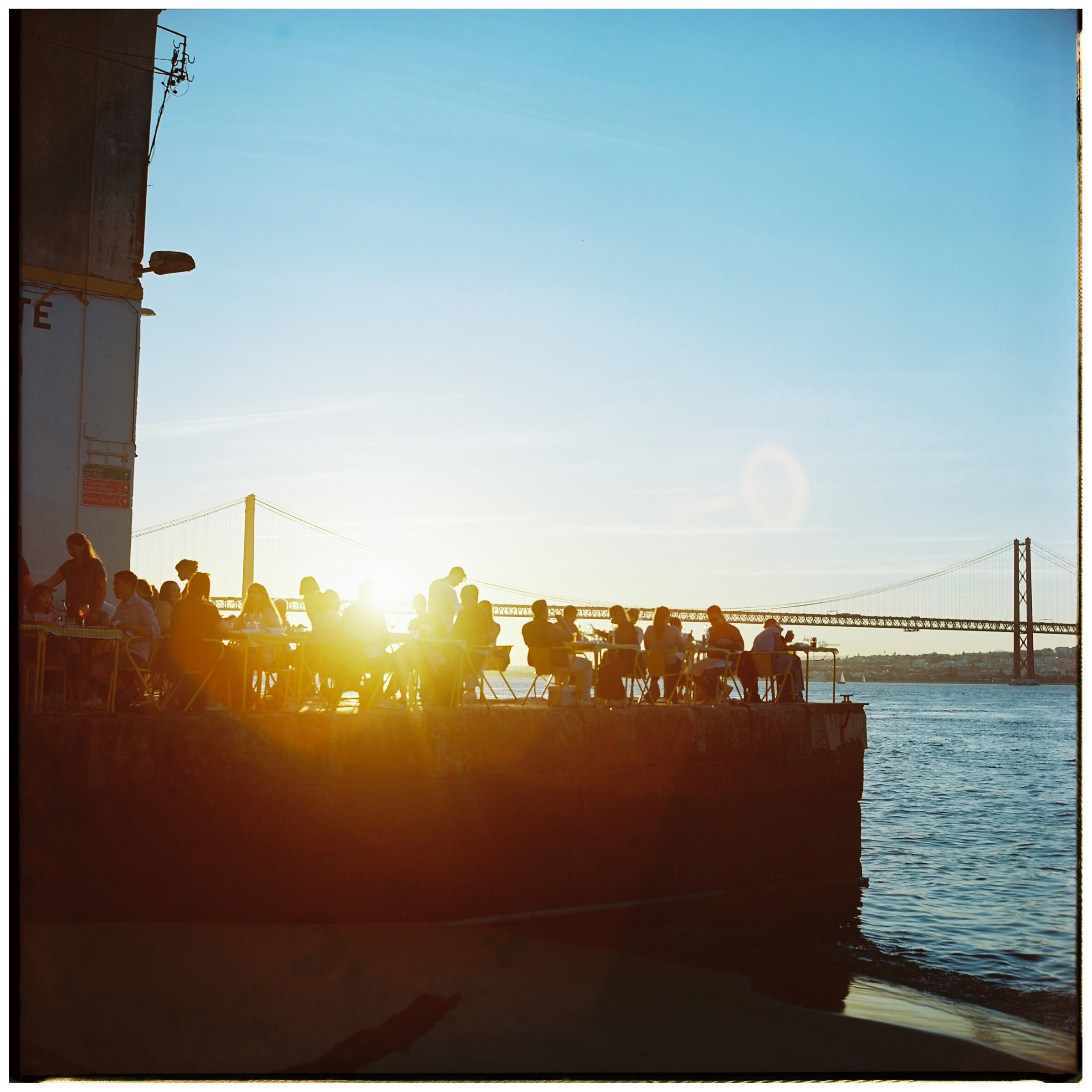
The difference between a week your team remembers and one that feels generic comes down to three key moments:
The welcome table
People decide what kind of week it will be within two hours of landing. They are jetlagged, arriving from different time zones, and often meeting in person for the first time. That first evening carries a specific, slightly awkward energy that either softens into warmth or hardens into fixed seating groups for four days.
A food-forward welcome dinner uses high-craft hospitality, a great setting and great food to break down barriers immediately:One conversation space: A private room or unique, photo-worthy setting configured so the group mingles rather than splitting into separate, isolated cliques.
Intentionally shaped tables: Layouts that encourage mixing across departments rather than self-sorting.
Shared-plate dining: Family-style platters placed down the middle and passed by hand, forcing physical interaction and conversation over plated silence.
Protected arrival pacing: Our default is an evening arrival the night before work starts, so the first morning workshop opens fresh rather than jetlagged.
The room where the work happens
Food fuels the minds you bring together to brainstorm, align, and solve hard problems. But cognitive energy requires both culinary and spatial design:
In-room regional refreshments: Fresh bread, local pastries, fruit, and espresso set up inside the workshop room before sessions begin—replacing cold corridor coffee queues at 11:00 AM.
Natural daylight with outdoor views: Direct views of courtyards, vineyards, or rivers to keep mental energy high during long strategy blocks.
Moveable surfaces & reconfigurable furniture: Mobile whiteboards and modular tables that shift easily from plenary setups to small breakout circles.
Tested technology: Large screens, wireless casting, and high-density Wi-Fi pre-tested in the room by our team prior to arrival.
Quiet nooks: Dedicated corners for spontaneous one-on-one catch-ups.
The send-off celebration
Most retreats happen after a major milestone—a launch, a funding round, or a brutal quarter. Recognition belongs on the agenda as a main event, not as an afterthought hotel dinner preceded by a rushed, artificial team-building exercise.
When designed properly around regional culture, celebration and team bonding become one thing:
Participatory immersion: A guided vineyard walk, cellar tasting, and barefoot grape treading in traditional granite lagares (stone wine vats), ending in a long outdoor harvest dinner.
Unfiltered connection: Speeches and formal reflection centered around a single long table with regional wine pairings inside a heritage estate, quinta, or port lodge.
This isn’t a theory about connection through food, it’s behavioral science. Research across studies totalling nearly 1,500 participants, found that people eating from a shared plate cooperated more and reached negotiated agreements faster than those eating identical food from separate plates. The effect held among strangers. Coordinating over a shared dish subtly trains people to coordinate over everything else
Managing food and beverage correctly
Food and beverage represents 25% to 30% of a retreat budget. It is also the most common complaint on post-retreat surveys.
While standard event planners treat catering as a logistical line item, strategic retreat design uses food to manage group energy and pacing.
We test every venue first: We visit and taste every restaurant, lunch spot, and menu before showing it to a client.
We brief the kitchen on the meeting agenda: Light, high-protein midday meals keep afternoon workshops sharp, while evening dinners are unhurried for open conversations
We vary the dining style: Not every meal needs to be an elaborate production. Most should be quick and high quality; two should be unforgettable.
Inclusive dietary management: We plan on the assumption that a meaningful share of any international group will have dietary requirements. Standard catering treats these as separate "substitute plates," that often feel more like side dishes. By designing family-style and vegetable-forward menus from the start, everyone eats together seamlessly.
What this costs in Portugal
RetreatsAndVenues puts average corporate retreat spend at €2,500–€3,400 per person across destinations, and reports a 4-day Lisbon strategy offsite for 20 leaders at roughly €3,500 per person all-in. Our own projects for 10-person leadership teams over 4 to 5 nights typically land between €20,000 and €35,000 before flights. This covers boutique or 5-star lodging, meeting spaces and AV, all daily meals, guest speaker/facilitator, private ground transport, a guided outdoor day, two custom celebration dinners, and dedicated on-site production.
Small groups carry higher fixed costs per guest because room block discounts unlock at 15 to 50 rooms; per-person efficiency improves significantly for groups of 20 to 60+ guests.
Four-Markets, All-In Cost Comparison
The difference is not that Portugal is cheap—it is value density. At €2,000 to €3,500 per guest, you are securing an exclusive boutique estate, quinta, herdade or 5-star property with chef-led dining and dedicated on site event producers throughout.
In Tier 1 hubs like London or New York, that same budget competes for a standard business hotel before gratuities and service charges are even added. All options produce a good week; only one delivers an experience that could not have happened anywhere else.
This is not a RuaMar estimate.The Incentive Travel Index (run annually by the Incentive Research Foundation and the SITE Foundation with Oxford Economics, from 2,708 respondents across 85 countries) reports average per-person program spend of $6,000 in North America against $3,200 in Western Europe.
The on-site production gap
While your team focuses on high-level strategy, execution requires dedicated real-time management. Managing room setups, sourcing local EU technical gear to avoid tariff delays, coordinating dietary preferences directly with chefs, and maintaining contingency plans for weather are operational loads that fall outside standard hotel contracts.
Drawing on 15 years of live production experience internationally, RuaMar bridges the space between hotel hospitality and event production across Portugal—ensuring pacing, dining, and logistics serve your core business outcomes.
Planning an Offsite in Portugal? Let's discuss your team's upcoming strategy offsite, pacing requirements, or custom production needs.
Common Questions on Offsite Planning in Portugal
-
Because the venue and business agenda are usually handled well, while the space between them is unmanaged. Pacing, room configuration, meal briefs, and evening transitions are not part of a standard hotel contract, but they determine how well a team connects
-
Structured activities work when the team has chosen them and when they are not scheduled directly after long work sessions. They fail when used to fill calendar gaps because scheduled exercises force artificial participation. Shared meals, unhurried walks, and hands-on culinary experiences achieve connection naturally.
-
Rather than booking artificial activities like escape rooms, food-forward design uses shared dining—family-style meals, vineyard harvests, cellar walks, and cooking sessions—as the social anchor. High-quality hospitality breaks down workplace hierarchy naturally.
-
It is the most critical hour of the trip. Teams establish social dynamics within two hours of arrival, and the first evening either mixes the group or locks in fixed seating arrangements for the entire week.
-
Natural daylight with scenic views, moveable whiteboards, reconfigurable furniture, pre-tested wireless AV, in-room food/coffee staging, and quiet corners for one-on-one catch-upscription
-
With a designed culinary celebration rather than a standard hotel dinner. Teams should choose between an active participatory close (like a private vineyard harvest) or a quiet plated dinner for speeches and reflection
-
A 10-person leadership offsite over 4 to 5 nights typically costs €20,000 to €35,000 before flights (€2,000 to €3,500 per guest). Larger groups of 20 to 60+ guests achieve better per-person cost efficiency due to hotel room block discounts.
-
Food and beverage represents 25% to 30% of a European retreat budget. Full-day F&B for a group in Lisbon averages €40 to €60 per person per day, compared to €60 to €95 in Paris and €65 to €130 in London.
-
Design menus where the default is already inclusive: family-style service, vegetable-forward courses, and allergens separated at source, rather than serving individual substitute plates.
-
Sourcing AV gear, technical staging, workshop materials, and participant gifts locally inside the EU removes international customs holds, tariff charges, and shipping delays.