The short answer
The best corporate retreat gifts from Portugal are things people wear, use or taste after they get home:
a Burel wool cap or an organic cotton tee made in Portugal
a cork notebook and a Viarco pencil for the desk
flor de sal, olive oil or Azorean tea that fits in a carry-on
a silver filigree bead bracelet or a cork bag for leaders, speakers and milestones
Skip the logo swag. A good gift represents your brand with care and still gets used months after the retreat ends.
Made in Portugal, often without the label
The swag line is often the most wasted money in a retreat budget. Nobody needs another plastic power bank or a tote bag that goes straight to recycling.
Portugal is a better place to shop because it has made things for the world for generations, usually without taking the credit. Portuguese cork helps protect NASA's Artemis rockets. When Bad Bunny wore a cream "Ocasio 64" sweater at the 2026 Super Bowl halftime show, it came from a textile company in Santo Tirso, north of Porto, and carried the birthdate of the late uncle who taught him the game.
Behind those headlines are workshops with long memories. Vista Alegre has made porcelain since 1824. Claus Porto has made soap since 1887. Viarco still makes pencils at Iberia's only pencil factory.
A gift from one of these makers comes with a story your team can tell at dinner back home. That is what makes it part of the program, not the backdrop.
How we choose a gift
When we plan a corporate retreat in Portugal, we treat gifting with the same care as the venue, the meals and the sessions. Every piece we advise a client to put in a room has to pass four tests:
It has a maker. A named Portuguese workshop with a story your team will enjoy learning about and sharing.
It gets used. Something people wear, carry or open at home, not something they’d leave in the hotel room.
It represents your brand thoughtfully. Subtle or bold is your call. We match the branding method to the piece, so it looks intentional either way.
It travels. It fits in a carry-on and clears airport security.
Our picks are independent. RuaMar is not affiliated with any brand in this guide. We don't earn commissions from these links, and no maker paid to be included. We chose each piece because it is authentic, made in Portugal and worth giving.
At a glance: the planner's cheat sheet
See how we pair local makers to match the pace of your offsite
| Gift | Price level | Best way to brand it | Travel note |
|---|---|---|---|
| Flor de sal and olive oil | € | Custom label or hangtag | Keep each bottle at 100 ml or less |
| Tinned fish | € | Ribbon, paper band or card | Up to 150 g in the cabin from Portugal. Check it on connections |
| Paupério biscuits or Arcádia chocolate | € | Ribbon or card. Keep the original tin or box | Biscuits travel well. Chocolate melts in summer |
| Viarco pencil and cork notebook | € | Name on the pencil, deboss on the cork | No limits |
| Azorean tea or Benamôr hand cream | € | Ribbon or card. Keep the original wrap | Cream: 30 ml goes in the liquids bag |
| Espresso cup and local coffee | € | Label on the coffee bag | Wrap the cup well |
| Cork slides or flip-flops | €€ | Branded shoe bag | Packs flat. Order a size range plus spares |
| Cork sunglasses or Torres Novas towel | €€ | Branded pouch, or an embroidered towel corner | Towel rolls into a tote |
| Organic cotton tee or Burel cap | €€ | Embroidery, tonal or bold | Cap is one size. Collect tee sizes |
| Cork laptop bag or backpack | €€€ | Laser engraving or blind deboss | Carries everything else home |
| Filigree bead bracelet | €€ to €€€ | Bead shaped around a motif. Date engraved | No limits |
€ under €25 | €€ €25 to €75 | €€€ €75 and up, per person, before branding
Sources: EU liquids rules | Lisbon Airport | Corkor
Everyday and welcome gifts
These are the pieces we use most, either waiting in the room on arrival or handed out on the last night. Start with the kind of retreat you're planning.
Build the kit
What kind of retreat is it?
Tap any item to read its story.
The idea
Pick a group to see a three-piece kit.
Every kit follows the same test: useful, carry-on friendly, and still in use long after the retreat ends.
For the card
To wear
The printed giveaway tee usually ends up as a gym shirt. Portuguese labels make tees that earn a place in the closet, not just the gym bag. ISTO. makes its organic cotton tees in Portugal and designs them to be worn year-round. +351, a Lisbon label, works in 100% organic cotton and produces in small batches. Add embroidery on the sleeve or hem and the tee becomes the one people reach for on a Saturday.
For a President's Club or sales incentive trip, skip the branded quarter-zips shipped from home, and the customs paperwork that comes with them, and choose by season. From October to April, Burel Factory's Short Zipper Jacket is made from the wool cloth once worn by Serra da Estrela shepherds. From May to September, or for the clubhouse after a round of golf, switch to pure linen shirts from Portuguese Flannel in Guimarães. Either way, people can wear their piece on the flight home, so it takes no suitcase space. Order early.
The Burel Factory cap is the gift people ask about. It is cut from burel, a woven and felted mountain wool that holds its shape, breathes, resists stains and ages well, and it closes with an adjustable leather strap instead of a plastic snap. It looks and feels nothing like a promo baseball cap. Burel Factory still weaves it in Manteigas on 19th-century looms, in colors the shepherds never had. One cap fits every head, so nobody needs a size.
For the first morning by the water
If the agenda includes boat transfers, coastal walks or a pool session, give this gift on arrival so people use it all week.
Footwear isn't the first gift most planners think of, but your favorite shoes may already be Portuguese. Harper's Bazaar reports that Portuguese factories make shoes for Loewe, Birkenstock and Miu Miu. Slides and flip-flops bring that quality to an easy gift, since they forgive a size. Order a simple size range with a few spares:
Asportuguesas calls itself the world's first cork flip-flop brand, with soles that blend natural cork and rubber.
Zouri began on a beach cleanup, when a shoe designer was told to put the plastic she collected into her shoes. She did. Its soles now mix natural rubber with plastic gathered from the Portuguese coast, and the shoes are handmade in Guimarães.
Pair them with sunglasses or a beach towel:
The Laguna sunglasses from Cultura Portuguesa, a cork shop in Porto's old town, mix recycled cork with recycled plastic and have UV 400 lenses. They solve the "I forgot my sunglasses" problem on day one, and nobody mistakes them for an event prop.
Torres Novas, founded in 1845, is Portugal's oldest home linen brand and the best-known name in Portuguese towels. Its 100% cotton towels are woven in Guimarães, the heart of Portugal's textile north, and it can weave or embroider a logo, as it does for hotels.
For the desk
Portugal produces about half the world's cork. A cork notebook is the easiest way in. It feels warm in the hand, shrugs off a coffee spill and slips into any bag.
Pair it with a Viarco pencil instead of another pen. Everyone already has a drawer full of corporate pens, and a pencil from Iberia's only pencil factory stays on the desk. Viarco also makes a scented collection, Backyards and Gardens of Portugal, in fig, orange flower and lavender. Sharpen one and the room smells like a Portuguese garden.
For the table
Consumables suit any budget and any group size:
Salt and oil: a small bottle of estate olive oil and a jar of flor de sal, the delicate crystals harvested by hand from the surface of Aveiro's salt pans.
A tin of fish: tinned fish is having a moment, from snack-plate posts to wine bar menus, and The New York Times calls it an "affordable luxury". Portugal never stopped eating them. At Conserveira de Lisboa, open since the 1930s and still run by the same family, staff wrap every tin in paper by hand at the counter. Its owner says the tin designs have barely changed, which is exactly why they look so good now. In Porto, Pinhais cans sardines in Matosinhos, at the city's edge. Torn between the two cities? See Lisbon or Porto for a corporate retreat.
A tin of biscuits: for anyone who doesn't eat fish, Paupério has baked biscuits in Valongo, near Porto, since 1874, and the same family still runs it. The tin looks as good on a shelf as a tin of sardines.
Figs and almonds: for an Algarve retreat, look to Quinta da Fornalha, a 35-hectare farm near Castro Marim where fig, almond, olive and carob trees grow. Its farm shop sells organic dried figs, fig truffles with dark chocolate and almond, and fig jam, plus herb olive oils and flor de sal harvested in Castro Marim, so one stop can cover a whole kit. Figs have deep roots here: stuffed figs were first made in Olhão as energy food for fishermen.
Chocolate: Arcádia, a Porto family business since 1933, is known for Port wine bonbons and línguas de gato, thin cinnamon and lemon "cat's tongue" biscuits. Save it for the cooler months, since chocolate melts in summer heat.
Tea: organic green or black tea from Gorreana in the Azores, Europe's oldest tea plantation, in production since 1883. Add wildflower honey or a bar of Portuguese dark chocolate.
Something for winding down: after a full day of sessions, a 30 ml Benamôr hand cream from a Lisbon beauty house founded in 1925, or a Claus Porto soap in its illustrated wrap, turns the hotel room into a small reset.
For mixed groups, pair tins of fish with something everyone can enjoy, like flor de sal, Azorean tea or Paupério biscuits.
For coffee people
In Portugal, a coffee means an espresso. Lisbon calls it a bica and Porto calls it a cimbalino, as Barista Magazine explains. Many people drink it standing at the counter.
Bring that ritual home in a cup with a story. In the hills near Vila Real, the village of Bisalhães makes black clay pottery, smoothed with pebbles and fired the old way until it turns deep black. UNESCO lists the craft as heritage in need of urgent safeguarding, and only seven potters and their families were still working when it was listed in 2016. A small Bisalhães cup is a gift almost nobody back home will have seen, and it helps keep the craft alive. Luisa Paixão sells cups and mugs thrown by Jorge Ramalho, one of the potters keeping the tradition going.
For larger groups, choose porcelain from Vista Alegre, Portugal's first porcelain factory, founded by royal license in 1824. Add beans from A Carioca, a Chiado coffee shop open since 1936, where staff still blend and grind to order. Tuck in a card on how to order a bica, and the morning coffee at home becomes a small trip back.
For leaders, speakers and milestones
Some of Portugal's best craft sits at a higher price. Save it for leadership offsites, guest speakers or milestone trips rather than a 50-person welcome bag.
Filigree, made modern
Filigree is the fine silver and gold wirework of northern Portugal, twisted and coiled by hand into lace-like shapes, a heritage craft that has stepped out of the heirloom jewelry box and into modern style. Porto designer Liliana Guerreiro works with filigree artisans on contemporary pieces that have been shown at MoMA and the Museum of Arts and Design in New York. In 2019, the Porto jeweler David Rosas opened House of Filigree, a museum, workshop and boutique set up to protect handmade filigree.
For a team gift, we like a simple cord or leather bracelet with a single filigree bead. It works for anyone and sits easily next to a watch. Jewelers like Torres and Joalharia do Carmo design custom pieces, so the bead can echo a shape from your company mark or carry the date of the gathering. The TAP x Portugal Jewels bracelets show the idea: a cord in the airline's red or green with one traditional Viana bead. The result reads as a handcrafted take on your brand.
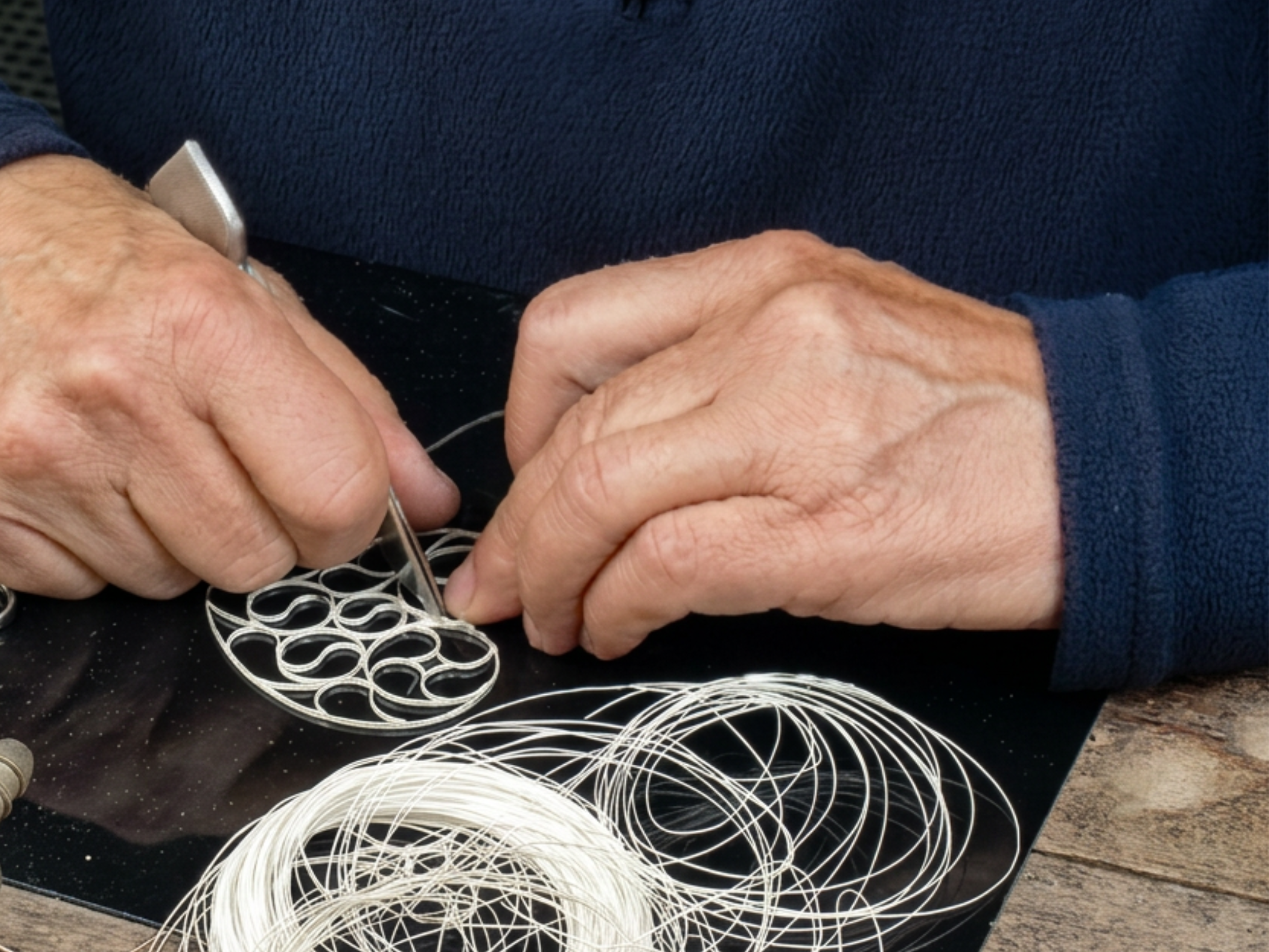
Photo: Paula Fontes Moreira / Wikimedia Commons, CC BY-SA 4.0
Cork bags that surprise people
Forget the idea of a wine stopper for a moment. Cork made for bags is soft and warm to the touch, closer to suede than to wood, lighter than leather and happy in the rain. Every panel has its own grain, so no two bags look quite alike. People pick one up and don't want to put it down.
Cork has gone fashion, too. In Paris, LaFlore built a following around its cork Bobobark bag that comes from Portuguese forests. For a team gift, we go straight to the source:
Corkor, a family business just south of Lisbon, makes cork laptop backpacks and briefcases and runs a corporate gifting program.
Pelcor makes clean, structured cork sleeves, bags and backpacks. Its cork pieces were shown at the MoMA Design Store in New York in 2010.
The Pati backpack from Cultura Portuguesa, designed and made in the north of Portugal, or the travel bag from Cork & Co, a concept store in Lisbon's Bairro Alto that also sets up gift pop-ups at corporate events. It folds flat when empty, so it packs easily and comes home full.
The practical side
Branding
Almost every piece here can carry your brand: embroidery on tees and caps, laser engraving or debossing on cork, a line hot-stamped along a Viarco pencil, a custom bead in filigree. Corkor, for example, offers engraving, debossing and embroidery, and branded pencils for businesses make up half of Viarco's sales, Monocle reports. For sunglasses, slides and heritage-wrapped products like Claus Porto or Conserveira de Lisboa, a branded pouch, ribbon or card usually looks better. The cheat sheet above shows the best method for each piece, and for the retreats we plan with clients, we coordinate directly with the workshops so every piece arrives ready for check-in.
Three travel rules
Keep liquids at 100 ml (3.4 oz) or less. Oil, honey and hand cream count as liquids under EU hand luggage rules.
Pack tins in checked bags on connections. Portuguese airports allow tins up to 150 g net in the cabin, but other airports may treat them as liquids, so Lisbon Airport suggests checked luggage and checking every airport on the route.
Leave out cheese and cured meat. Great Britain bans travelers from bringing meat and dairy in from the EU, including cheese and cured meats. The US requires travelers to declare all meat, and US Customs and Border Protection restricts many meat products.
Timing, budget and delivery
Order custom work early. Corkor quotes 1 to 2 weeks for engraving on items not in stock, 3 to 4 weeks for embroidery and 6 to 8 weeks for fully custom pieces. Many workshops slow down in August and over the holidays. See how far ahead to plan a retreat in Portugal.
Tier the gift, not the quality. Everyone gets a welcome piece. The higher-ticket gifts go to leaders, speakers or hosts.
Buy one good thing rather than five small ones. A single piece with a story gets kept. A bag of extras gets left in the room.
Put it in the per-person number. Gifts are a budget line like any other. See what drives cost per person.
Deliver it like hospitality. A gift handed out at registration feels like conference swag. The same gift on in the room at check-in, with a two-line note on who made it, feels like a welcome.
What to leave out
Pastéis de nata to take home. They are meant to be eaten warm on a mid-morning break (or as often as possible), not crushed in an overhead bin.
Cheese and cured meats. Tempting, but they hit border rules in the UK and the US.
Generic tech. Earbuds and charging cables read as promotional, not a local nod to your Portuguese retreat.
Anything that needs a second suitcase. Keep every piece carry-on friendly.
Frequently asked questions
-
Pick things people will wear, use or taste: Burel wool caps, cork goods, Viarco pencils, tinned fish, flor de sal, olive oil, Azorean tea, Bisalhães black clay and silver filigree. Choose pieces from named Portuguese makers that fit in a carry-on. Each one supports local craft and tradition, and most are rarely seen outside Portugal.
-
A cord or leather bracelet with a single filigree bead, shaped around a motif from your brand. It is unisex, easy to wear every day and made by hand in northern Portugal.
-
Yes. Almost every piece can carry your logo, from embroidery on a tee or cap to engraving on cork or silver. For sunglasses, slides and products in heritage packaging, the pouch, ribbon or card usually works better.
-
Olive oil and honey, yes, in containers of 100 ml (3.4 oz) or less. Portuguese airports allow tins up to 150 g net in the cabin, but other airports may treat them as liquids, so pack tins in checked luggage for connecting flights.
-
No. Great Britain currently bans travelers from bringing meat and dairy products in from the EU. Choose olive oil, tea, honey or chocolate instead.
-
It’s up to your team’s taste, but yes, especially now. Tinned fish has become a food trend in the US and UK, and Portugal has canned sardines for generations. A tin from Conserveira de Lisboa or Pinhais is beautiful, costs little and starts conversations. Pack tins in checked luggage for connecting flights. For anyone who doesn't eat fish, a vintage tin of Paupério biscuits works just as well.
Plan a retreat people remember
Gifts are the last thing guests take home, so they should feel like the rest of the week. We can support you in choosing the makers, handle the branding and place each gift as part of the program. Tell us about your team, and we'll design a retreat where Portugal is part of every day.